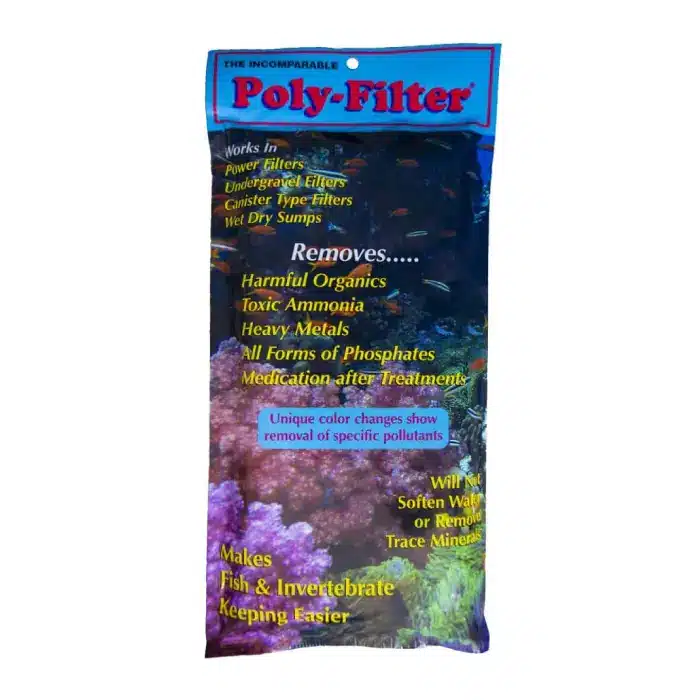
This is due to its high absorbency and capacity to change color as it gets saturated with contaminants, which acts as a visual indicator for replacement. The small pad can work efficiently because it continuously draws in water, ensuring that the entire tank volume gets treated over time, helping maintain optimal water quality with minimal maintenance.
Polyfilter is also widely praised for its ability to work in both saltwater and freshwater aquariums, making it versatile for hobbyists who keep different types of aquatic systems. Since it doesn’t rely on mechanical filtration alone, it’s especially useful in aquariums that might experience sudden spikes in waste or toxins.
One of the key features of Polyfilter is its ability to change color based on the type of contaminants it is absorbing, which provides a visual cue for what’s being removed from the water. As it becomes saturated with different substances, the filter turns distinct colors:
• Brown: Indicates the removal of organic waste or debris.
• Green: Signals the absorption of ammonia, which is highly toxic to fish.
• Blue: Points to the extraction of copper, often present in medications used in aquariums.
• Red: Shows the removal of iron or other heavy metals.
• Yellow: Indicates the absorption of excess phosphate, which can lead to algae growth.
This color-changing property makes it easy to monitor the water’s condition and tells you when the filter is nearing its capacity. Once fully saturated, the pad will need to be replaced to ensure continued effective filtration. The color variation is especially helpful for detecting hidden issues, like toxic metal contamination, that might not be immediately noticeable.